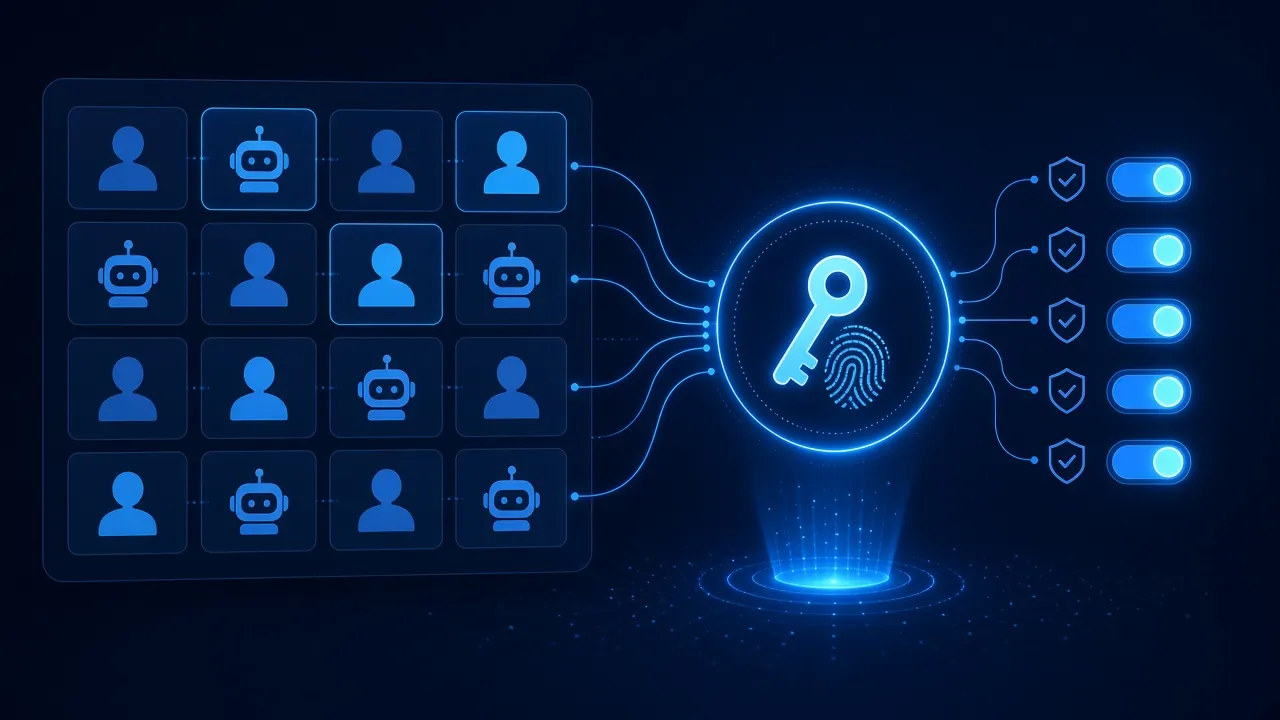
IBM said on Oct. 26 that IBM Agent Identity is now generally available, a product meant to give companies a single place to register AI agents, control what they’re allowed to do and trace what they did.
The company frames the problem in its announcement as basic questions many organizations can’t answer. They often don’t know which agents are running, who owns them, what authority those agents have or which actions they took and at whose direction, the company wrote.
Traditional identity systems were built for people, applications and fairly stable machine accounts, IBM wrote.
Agents mix all of those. They act with authority delegated by a user, run as software, make decisions based on context and sometimes hold privileged access. IBM argues that means identity checks have to stay active for a whole task, not only when a session begins.
How it works
Agent Identity starts with an inventory. Companies register each agent, record its owner, classify its risk, list the tools it’s approved to connect to and track where it is in its lifecycle, according to IBM. The product documentation describes giving each agent a lasting, purpose-built non-human identity.
From there, the product tracks delegation. When an agent acts on a person’s behalf, IBM says Agent Identity keeps that link intact across identity providers and token exchanges, so an action can be traced back to the person, approval or system that started it.
Access is narrowed step by step.
The product uses short-lived tokens built on OAuth, a common standard for granting limited access without sharing passwords, scoped to a single task. Sensitive actions can require extra consent. While an agent runs, IBM says the product evaluates risk and enforces policy, rather than granting broad standing access.
At the end, audit trails connect the human, the agent’s delegated identity, each credential issued, each policy decision and the actions that followed. IBM pitches that record for compliance reports and incident investigations.
Vault and the rest of the stack
IBM pairs the product with its existing security tools. IBM Verify handles identity, authorization, token exchange and audit. HashiCorp Vault, which IBM owns, protects secrets and issues just-in-time credentials for older systems that can’t accept delegated tokens, the company says.
In a related announcement at its TechXchange 2026 conference in Atlanta on Oct. 27, IBM said Vault will extend to AI agents, issuing short-lived credentials limited to what each agent needs and allowing real-time revocation when an agent tries an unauthorized action. The same release said watsonx Orchestrate, IBM’s agent platform, is designed to discover and evaluate agents built on Amazon Bedrock, Microsoft Foundry and Google Gemini.
IBM cited Gartner figures in that release. It said Gartner expects the average Fortune 500 company to use more than 150,000 AI agents by 2028, and that only 13% of organizations believe they have the right agent governance in place.
“For agents to take on real work across the systems a company depends on, it requires an AI operating model,” Dinesh Nirmal, senior vice president of IBM Software, said in the release.
IBM says the product is designed to work alongside identity providers companies already use, so they don’t have to replace existing workforce identity systems. It didn’t publish pricing in the announcement.
Source: IBM, “IBM Agent Identity is now generally available: Building trust for the agentic era”
Additional sources: IBM Newsroom, IBM, “IBM Introduces Identity and Control for AI Agents, Securing Frontier Intelligence for the Enterprise”; IBM Documentation, IBM, “Concepts, IBM Agent Identity”